2009/11/16
I’ve said so before, sometimes new articles are found in new and unlikely places. The other day I was proofreading the paper of a colleague and something caught my attention in her reference list. A brand new article, just out: Managing disruptions in supply chains: A case study of a retail supply chain by Adegoke Oke and Mohan Gopalakrishnan. Now, here was a chance to learn something new…so I thought, and so I did. However, I’m not sure I follow the authors in their risk categorization: supply, demand and “miscellanous” risk? What is this “miscellanous” risk?
» Read more » » »

2009/11/11
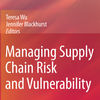
Another book by someone from the ISCRIM gang? No, not this time, or perhaps, yes, after all. Managing Supply Chain Risk and Vulnerability: Tools and Methods for Supply Chain Decision Makers
by Teresa Wu and Jennifer Blackhurst sounds like ISCRIM, but it’s not. If it were, it should have been noted in the ISCRIM Newsletter, but it wasn’t. Nonetheless, several of the ISCRIM members have contributed to the chapters in this book, which is well worth taking a closer look at, particularly if risk modeling and decision-making is your field.
» Read more » » »

2009/09/28
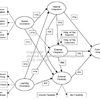
How does company culture shape a firm’s risk mitigation and response, and thus, how does company culture shape a firm’s supply chain agility? That is the research question asked by Michael J Braunscheidel and Nallan C Suresh in their 2009 article The organizational antecedents of a firm’s supply chain agility for risk mitigation and response. The article was suggested to me by one of my readers as his ‘favorite’, and after reading it I do understand why, because it links up with and extends many previous works on supply chain flexibility and supply chain agility.
» Read more » » »

2009/08/24
After studying supply chain risk research for some time I have begun to realize that much of the supply chain risk literature lacks direction and that each researcher or strand of researchers have their own presuppositions as to what supply chain risk is and how it should be addressed. In Knemeyer, A. M., Zinn, W. & Eroglu, C. (2009) Proactive planning for catastrophic events in supply chains, fortunately, there is a clear direction for further research and practical application as to how companies can evaluate and plan for catastrophic risk in supply chains.
» Read more » » »

2009/06/12
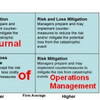
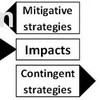
The risk management literature separates between mitigative actions or strategies and contingent actions or strategies. It is important to keep these two perspectives apart. Why? Because risk management needs to address both sides of the risk: what lies behind the risk (source) and what lies in front of it (consequences). Here is my attempt at defining these two terms and explaining the differences, at least the way I see it, based on Asbjørnslett (2008), Tomlin (2006) and Jüttner et al. (2003).
» Read more » » »
Recent Comments