|
|
All posts tagged gis
 2010/03/13  BOOKS and BOOK CHAPTERS
 
This is a book I’ve wanted to lay my hands on for a long time. The Geography of Transport Systems by Jean-Paul Rodrigue, Claude Comtois and Brian Slack is a book that every geographer with an interest in transportation should read. It is also a book that every transportationist with a sense for geography should read. Even if your main focus is just transportation and nowhere near geography, this book will fascinate, because it so brilliantly explains, explores, researches and reviews the spatial impact of transportation systems and how they have shaped the world that surrounds us. It is not often that I fall in love with textbooks at first sight, and this is a book that will not spend much time collecting dust in my bookshelf, as I will read and use it again and again…
» Read more » » »
 2005/03/05  BOOKS and BOOK CHAPTERS
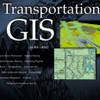
This book showcases many examples of how GIS can be applied in the field of transportation using ArcView GIS, but it doesn’t come with any theory. As such, Transportation GIS more like an overpriced ESRI sales brochure and not a textbook. Nevertheless, the examples are really neat and should inspire any practitioner in the field.
» Read more » » »
 2003/08/25  BOOKS and BOOK CHAPTERS
Having been a student with Harvey Miller at the University of Utah 200o-2002 probably makes my review somewhat biased. Nevertheless, Geographic Information Systems for Transportation: Principles and Applications (Spatial Information Systems) written by Harvey Miller and Shih Lung shaw is an excellent book if you’re a student or professional in the field of GIS and need to know how GIS can be applied to transportation, or vice versa, knowing transportation, this book will tell you what GIS can do for you.
» Read more » » »
This tutorial was developed by Jan Husdal at the University of Utah, Salt Lake City, 2000-2002. It shows how to solve 3 categories of network analysis problems; Find Best Route, Find Closest Facility and Find Service Area, and it comes complete with exercise data and solutions.
» Read more » » »
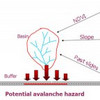
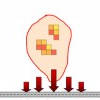
Traditionally, in studying the effect of hazards on roads, a hazard map is prepared based on the hazard in question, the contributing factors and then overlaid with a road map. If the road or a buffer around its vicinity intersects hazard areas, these areas constitute a potential threat.
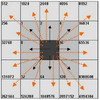
In the approach used in this procedure, imagine traveling along the road and looking to either side for hazards. The neighborhood that needs to be examined is dependent on the hazard and its contributing factors. This neighborhood search then produces a hazard map that is directly related to the road.
» Read more » » »
|
Literature Reviews Sorted by last name of first author:
A | B | C | D | E | F | G | H | I | J | K | L | M | N | O | P | Q | R | S | T | U | V | W | X | Y | Z
|