|
|
Economic resilience, as defined a paper published by the Multidisciplinary Center for Earthquake Engineering Research (MCEER), refers to the inherent and adaptive responses to hazards that enable individuals and communities to avoid some potential losses. It can take place at the level of the firm, household, market, or macroeconomy.
» Read more » » »
The other day I received an email from the editorial board of Transportation Science, asking me to review an article that had been submitted for publication. Transportation Science promotes itself as the foremost journal in the field of transportation analysis, and is published quarterly by INFORMS, so I felt quite honored. This is not the first time I’ve been asked to review a journal submission, but every time is still a new experience.
» Read more » » »
I joined two days ago, and it has been very rewarding so far. The Supply Chain Network SCN markets itself as the place where supply chain academics and professionals connect and providing visibility to SCM professionals around the globe.The sign-up is fairly straightforward. Initially I was put off a bit because I was required to leave quite a bit of personal information (professional expertise and such), but then again, how can you connect
if you don’t know anything about that person? So, this is actually a good thing. On the other hand, as I discovered later, if you prefer to leave “nothing”, you can always type “-” instead of adding any information.
» Read more » » »
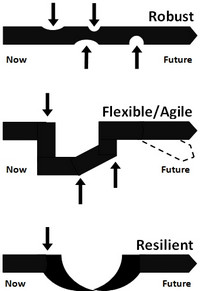
In a previous paper, back in 2004, I discussed the issue of Flexibility and robustness as options to reduce risk and uncertainty. Since then a new term has emerged: resilience, and today I would like to compare these three terms. Robustness is the ability to accommodate any uncertain future events or unexpected developments such that the initially desired future state can still be reached. Flexibility is the ability to defer, abandon, expand, or contract any investment towards the desired goal. Resilience is the ability of a system to return to its original state or move to a new desirable state after being disturbed.
» Read more » » »
Risk Central is a private and personal initiative and web portal started by Roberto Pinto, assistant professor and Ph.D student at the University of Bergamo, Department of Industrial Engineering – with the aim at collecting and share with other interested people news, facts, stories, events, experiences, discussions and whatever could be related to Risk Management, Business Continuity Management, Vulnerability Management, Resilient Enterprise and related topics.
» Read more » » »
|
Literature Reviews Sorted by last name of first author:
A | B | C | D | E | F | G | H | I | J | K | L | M | N | O | P | Q | R | S | T | U | V | W | X | Y | Z
|