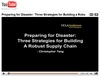
 How could I have missed this paper? I was preparing my 2009-lecture on supply chain risk for tomorrow and while looking for some YouTube videos on supply chain risk to spice up my 3-hour presentation, I came across a short snippet featuring Christopher Tang from UCLA, who was talking about three strategies for building a robust supply chain, related to (1) supply, (2) product, and (3) demand. The video does not refer to it, but fascinated as I was, I did some more digging and came up with his 2006 paper Robust strategies for mitigating supply chain disruptions, which list not three, but nine strategies.
Product , Supply, Demand
In the video, Tang refers to 3 incidents that identify the three strategies:
Product: Nokia changed product configurations in the nick of time to meet customer demand during a supply disruption, the infamous Albuquerque Philips plant fire.
Supply: Hong-Kong based Li and Fung changed its supply plan in a flash to meet customer demand during a currency crisis, the 1997 Asian meltdown.
Demand: Dell changed its pricing strategy just in time to satisfy customers during supply shortage, after the 1999 Taiwan earthquake.
Nine strategies
These three incidents are highlighted in the above mentioned paper. In addition, Tang lists six more strategies that can make supply chains more robust, nine strategies in all:
- Postponement
- Nokia’s modular design allowed it to switch to other components after the supply shortage
- Strategic stock
- Planned stockpiling of regular demand at central locations to serve areas in need or shortage
- Flexible supply base
- If one supplier goes down, the other can take over, some for basic demand, some for high volume fluctuations
- Make and buy
- Always keep some production in-house, outsource basic items, make high-end items in-house
- Economic supply incentives
- Commit to buying certain quantities from a certain supplier to keep the (backup) business running
- Flexible transportation
- Muliti-modal, multi-carrier, multi-routes transportation, avoid chokepoints
- Dynamic pricing and promotion
- Sell what you have, don’t delay or promise to supply what you don’t have
- Assortment planning
- For retailers, displaying what’s in stock, influence customer choice and demand
- Silent product rollover
- Do not market the introduction of new products or the end of old products
That easy?
Christopher Tang is an excellent speaker and an excellent writer. After seeing the video, and reading the paper, all I can say is “Wow. Is it really that easy”? Perhaps it is, if you start to think about it. How much of the above is actually just common sense? Maybe we don’t need big fancy theories and complicated frameworks. As some famous company has said before, Think Simple. I think it’s time for that.References
Tang, C. (2006). Robust strategies for mitigating supply chain disruptions International Journal of Logistics, 9 (1), 33-45 DOI: 10.1080/13675560500405584
Author link
- ucla.edu: Christopher Tang