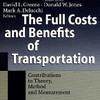
 This book, The Full Costs and Benefits of Transportation: Contributions to Theory, Method and Measurement, edited by David L. Greene, Donald W. Jones, and Mark A. Delucchi is a welcome addition to the field of cost-benefit analysis in transportation, albeit first published more than 10 years ago. It contains individual contributions from 20 or so respected academics, each describing a separate field of study. I have seldom seen a fuller and more holistic approach to cost and benefits in transportation research. But is it really worth buying? I borrowed it from my library and I’m not so sure I would recommend you to put it in your shopping cart. It IS a good book, that is for sure, but at what cost?
Holistic
Modern transportation systems have pervasive and far-reaching effects on society and the environment. Mobility and other benefits of modern transportation arrive with many, serious undesired consequences: deaths and injuries in transport accidents, pollution of air, water and groundwater, noise congestion, greenhouse gas emissions, to mention but a few. In this book leading international researchers explore the issues and concepts and define the state of knowledge concerning transportation’s full costs and benefits.
Individual works of excellence
As mentioned, 20 or so academics, from around the world, including the USA, Germany, Australia and France, have submitted their own ideas on costs and benefits. Displaying my ignorance, I have to admit I don’t know that many of them; perhaps I should, but I recognize their respective universities as leading institutions in the field of transportation. Two of them I do know: I have met Douglass Lee of USDOT in person, when attending the TRB Annual Meeting in 2004. He is head of the Transportation Economics committee at TRB. And I’ve run into David Hensher, ETC 2005 I think it was. David Hensher is one of the major figures in transportation research, so if both Douglass and Hensher are contributors than this IS a good book. Well, maybe they were not so famous 12 years ago, but ceratinly now.
Outdated?
The book is not new. It was first published in 1997, and although the empirical data may no longer be anywhere near true, the principles and methodologies still hold.