 Logistics uncertainty – a new research strand in supply chain risk research? So it would seem, as this is the fourth time I’ve come across the authors of today’s article. In their most recent article Evaluating the causes of uncertainty on logistics operations, just out, Vasco Sanchez-Rodrigues, Andrew Potter and Mohamed M. Naim further explore their transport uncertainty triad model which they started on some years ago, and whose articles have been mentioned on this blog in previous posts. It is only recently, though, that I have become aware of their research that links up perfectly with my own research in supply chain disruptions in sparse transportation networks, and it most definitely is a research that I intend to follow closely.
The Logistics Uncertainty Pyramid Model
The logistics uncertainty triad or logistics uncertainty pyramid model was first discussed in the authors’ 2008 paper on Establishing a transport operation focused uncertainty model for the supply chain, and was featured on this blog almost three months ago.
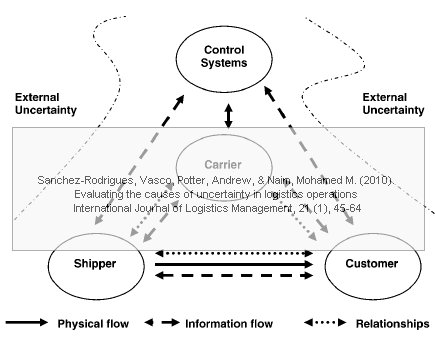
The figure above, taken from said article, describes what the authors define as the causes for uncertainty in the supply chain:
- Shipper
- Customer
- Carrier
- Control systems
- External uncertainties
Using a focus group the authors now go about exploring this concept further, by categorizing and mapping the occurrence of individual factors within the above groupings of causes.
Causes of transport uncertainty
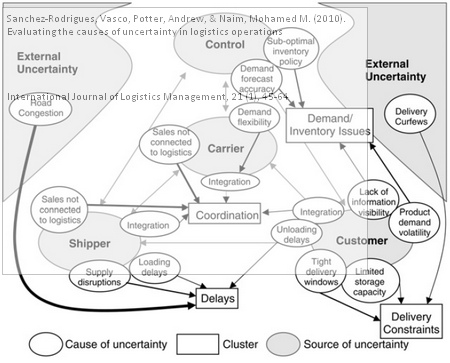
The focus group survey then leads to four clusters of uncertainty causes:
- Delays
- Demand and inventory issues
- Lack of coordination
- Delivery constraints
The figure below shows the interlinkage between the causes and clusters.
Conclusion
In my opinion, the Logistics Uncertainty Pyramid Model is an excellent tool that can be used to identify issues of uncertainty, and then map these issues against their sources, from which improvements plans can be developed. As to supply chain uncertainty, this is among the most practically applicable tools I have come across recently. This article is the second stage in the authors’ efforts to develop a framework for analyzing what they define as the causes for uncertainty in the supply chain, and I look forward too seeing their next article.
Reference
Sanchez-Rodrigues, Vasco, Potter, Andrew, & Naim, Mohamed M. (2010). Evaluating the causes of uncertainty in logistics operations International Journal of Logistics Management, 21 (1), 45-64
Author links
- linkedin.com: Vasco Sanchez-Rodrigues
- cardiff.ac.uk: Andrew Potter
- cardiff.ac.uk: Mohamed Naim
Related links
- agsystems.com: Freight Logistics