 Now it has happened again. Hardly a week goes by in Norway without a major supply chain disruption. Now the main (and practically only) highway beween the Northern and Southern part of Norway has been interrupted, prompting long detours on smaller roads. Not only that, the in fact only rail line between Trondheim and Bodø has been interrupted as well, a rail line that transports much of the goods between North and South Norway and is a major freight corridor. Normally, eight large freight trains pass every day. The irony is that this happened during construction work aimed at improving said road. In fact, this is the second time this year; in June the road and rail were closed for 12 days. This time, it’s looking like a couple of WEEKS!
In a previous article I contended that sparse transportation networks, like in Norway, are a recipe for supply chain disruptions. Furthermore, unlike in regions with a dense transportation network, supply chain management in a sparse network setting comes close to being business continuity management, because a well-handled supply chain disruption can translate into business continuity, while an ill-handled supply chain disruption can translate into business dis-continuity. Now, this minor incident is hardly going to cause any business dis-continuities in Norway, but, if like last time, the clear-up takes 12 days, or more, this will be a costly affair for all involved.
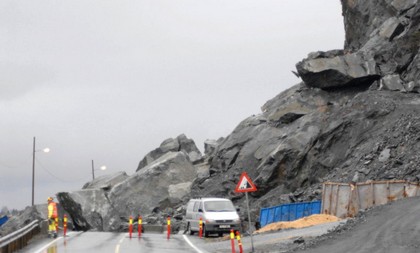
Transportation networks like freeways and interstate highways are the main backbone of modern society and play an important role in supply chains. Consequently then, the reliability of the transportation network or the reliability of supply chains is thus a decisive factor not only in terms of market outreach and competition, but also in terms of continuity, to ensure a 24/7 operation of the community we live in. Any threat to the reliability of the transportation network constitutes a vulnerable spot, a weakness in the supply chain. In Norway, this weakness seems to come to the surface more often than necessary.
Links
- NRK Trøndelag – Frykter nytt ras i Løsberga
- husdal.com – Sparse transportation networks – a recipe for supply chain disruption?
- dagbladet.no – Ikke trygt å rydde opp
- vg.no – Ryddearbeidet på E6 vil ta flere uker
Related
- husdal.com: Are roads more important than computers?
- husdal.com: Sparse tansportation networks