The vulnerability of the transportation network as part of the supply chain is of particular interest in countries or regions with sparsely populated areas, and hence, a sparse transportation network. Typically traits of such regions are few transportation mode options and/or few transportation link options for each transportation mode, for example maybe only one railway line and two roads, no port, no airport. It should not come as a surprise then that the nature of sparse transportation networks, and thus sparse supply chains, makes them vulnerable to many different kinds of internal and external risks.
Norway – a typical example
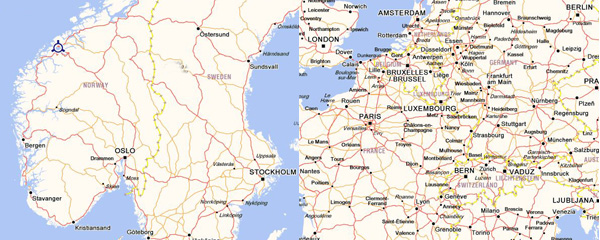
Road density in Norway vs Europe
With only a few transportation modes and links available between population centers, these population centers become extremely vulnerable to any disruption in the transportation system or supply chain, since in a possible worst-case scenario no suitable alternative exists for deliveries to or from these communities. The issue of sparse transportation networks is well illustrated in the figure left, showing same-scale maps of the road network Norway (the author’s home country) and Europe, taken from an online route planner. Lack of details and missing road links aside, it should come as no surprise that Central Europe enjoys a much better denser road network than the Scandinavian countries, and Norway in particular, and hence has many more rerouting options in case of disruptions.
Location matters
From the community is as important as to the community, since the supply chain goes both ways, meaning that no goods or supplies can come in and no manufactured goods or supplies to companies in other locations can leave. Few will question that the sender, the recipient, the freight hauler, or society at large, experience additional costs when goods or people cannot reach their destinations in time or in space. A non-functioning, or at best, badly-functioning link will impose costs on the user in terms of loss of time, additional operation costs or other costs as a result of delays and diversions. Transporters of perishable goods will also experience a loss of value.
The constrained supply chain issue
The question then arises, are businesses located in regions with sparse transportation networks in fact more prone to supply chain disruptions than businesses located in transportation-wise more favorable locations? Does the sparse transportation network influence the setup of the supply chain? Does a sparse transportation network in fact constrain the supply chain setup, such that it deviates from the ideal and thus is more vulnerable and more likely to be disrupted?
Update 2010 – the answer
Two years on, I am now about to answer the question. Yes, location matters, but being aware of your location matters more: How Norwegian freight carriers handle supply chain disruptions.