 This is the 3rd day with severe transportation and thus supply chain disruptions all over Europe, due to the volcanic ash cloud from Iceland, forcing travellers, cargo shippers and logistics providers to seek alternative solutions. In essence this is a very practical lesson in business continuity. Who would have thought that a volcano eruption in country that until recently and before the IceSave dispute did not make any headline news could create such havoc with widespread impacts? I certainly did not. Nonetheless, it is also a lesson in business creativity: German car rental company Sixt shows how.
Travellers
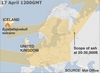 Leisure and business travellers are stranded all over Europe, according to the BCC, scrambling for whatever alternative transport they can find, buses, trains, rental cars, ferries… The cost to airlines, insurers and the travellers themselves is likely to be in the billions, and there is no end in sight, according to CNN. And because everything is so connected, it does not only affect flights in Europe but also flights from the Americas and Asia to and from Europe. Essentially, the whole route network across the globe is affected.
Life as usual
The irony is that Iceland itself is more or less unharmed by this as the winds are blowing the volcanic ash cloud away from the country and towards Europe. In fact, for a volcano scenario affecting Europe, Iceland does have the worst worst-case location as the prevailing winds are Westerly. Not “The Perfect Storm”, but certainly “The Perfect Volcano”.
Creative advertising
The current crisis has also seen some creative advertising. While airlines and other travel providers resort to the typical “Please bear with us as we sort out this crisis”-message on their homepages, German budget car rental company Sixt is different: They changed their homepage to accommodate the current situation in a fun way. The text reads “Gehen Sie nich in die Luft wegen so viel Asche. Mieten Sie für weniger bei Sixt”, which translates as “Do not take to the air because of all the ash. Rent for less with Sixt”.
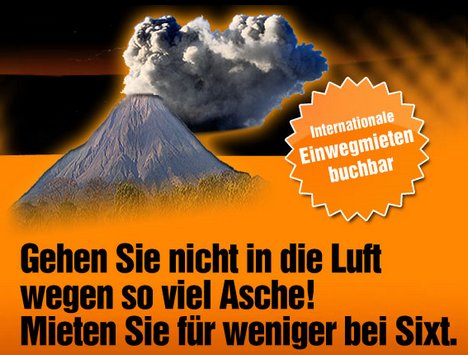
The pun, however, may escape most readers unfamiliar with German. While “Gehen Sie nicht in die Luft” literally means “Do not go into the air” or “Do not to take to the air” as in “Do not fly”, it is also a synonym for “Do not get mad” or “Do not explode”, since car rental prices have soared in a simple equation of supply and demand, and of course, because renters will not be returning the car to the same station, but hundreds if not thousands of kilometers away, maybe even in a different country. Creative, indeed.
What if?
The question that remains is, what if the volcanic ash cloud problem goes on for a prolonged period, say weeks or months of intermittent air traffic restrictions? Will we change our travel behavior? Will we start valuing slow travel again, like it used to be in the old days, before the aeroplane came? Will business meetings be replaced by teleconferencing and videoconferencing and will we perhaps realize that we do not need this face-to-face meeting that much? Maybe we really don’t need to be a able get every where in just a matter of hours? Or having our cargo delivered asap? As we say in Norway, “Nothing is so bad that it is not good for something”.
What about cargo?
While air is not the major mode of transportation for cargo, it still accounts for a considerable amount, particularly for high-value cargo or perishable goods. How will air freight companies handle this situation if it lasts much longer? And how will companies dependent on air freight for incoming materials or outgoing products cope?
Business continuity
Truly, this is a lesson in business continuity on a scale never seen before. It will be interesting to see the effects of the volcanic ash cloud, both short-term and long-term.
Links
- news.bbc.co.uk: Europe facing days of chaos
- cnn.com: Europe’s transport system is feeling the strain
- vg.no: SAS permitterer 2500
- tv2nyhetene.no: Ingen ende i sikte
Related
- husdal.com: Today’s transport disruption: Volcanoes