 Transportation vulnerability and resilience have been the focus of this blog for the past two days, first looking at Engineering Tranportation Lifelines and then Are roads more important than computers? Today I have a third article that relates to this subject: Assessing the vulnerability and criticality of the highway system. In 2002, AASHTO (the American Association of State Highway and Transportation Officials) published a guideline on how to perform such an assessment, and I had almost forgotten about it, but it came back to me when I was researching my two previous posts. What makes this report worth posting about is the clear and distinct separation of the terms vulnerability and criticality.
Vulnerability and Criticality defined
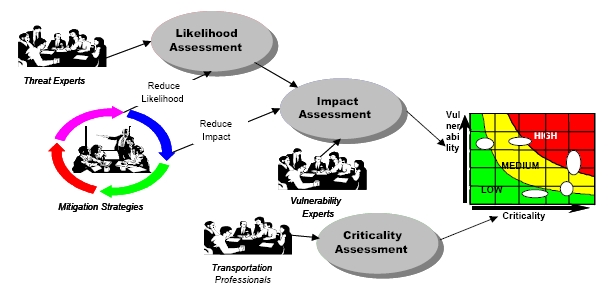
What aroused my renewed interest in the subject was the re-discovery of the figure below, which I had saved to my PC years ago, when I first read the the guideline on Assessing the vulnerability and criticality of the highway system. While being familiar with risk or probability/impact matrices, I don’t recall ever coming across a vulnerability/criticality matrix. How is this different from the classical risk matrix?
(Click image for larger version) Assessing the vulnerability and criticality of the highway system.
The aftermath of 9/11
First of all, criticality and vulnerability relates to all assets that are essential to the road authorities or operating agencies in fulfilling their mission. Published in early 2002, the guideline clearly comes off as being most concerned with critical assets’ vulnerability to terrorist attacks. That said, this does not diminish the value of the guideline today, although terrorist attacks may not be as high on the lookout agenda as they were in 2002.
Criticality
Critical asset factors are the criteria used to identify and prioritize critical assets. Collectively, these factors are an indication of the conditions, concerns, consequences, and capabilities that might cause an operating agency to label an asset “critical.” Each factor is assigned a value based on the importance of the factor in establishing an asset as “critical.” In the example below, the maximum criticality score is 43.
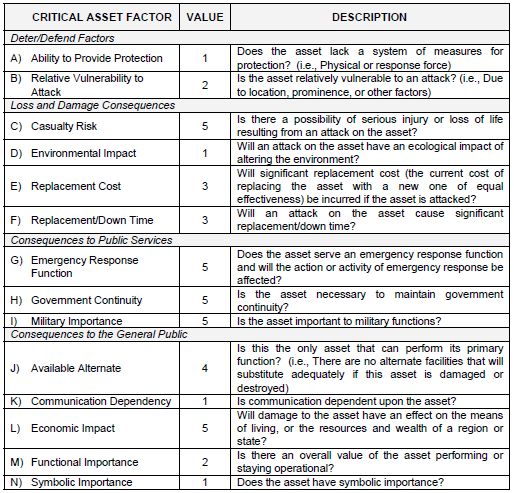
(Click image for larger version) Assessing the criticality of the highway system.
Vulnerability
The vulnerability assessment is designed to systematically identify and evaluate critical assets in terms of their susceptibility to and the consequences of terrorist attacks.
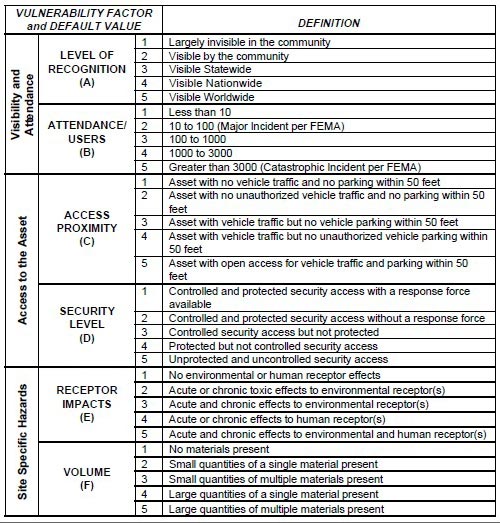
(Click image for larger version) Assessing the vulnerability of the highway system.
Step by step
All assets are scored for their criticality and vulnerability by various factors, and the criticality score translates to a x-coordinate, while the vulnerability score translates to a y-coordinate. This results in a criticality/vulnerability matrix.
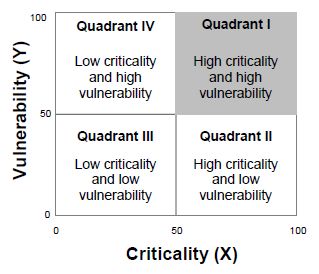
(Click image for larger version) Assessing the vulnerability of the highway system.
Conclusion
As already mentioned, this guideline is primarily concerned with assessing the vulnerability towards terrorists attacks. Nonetheless, the basic principles of the assessment of criticality vis-a-vis vulnerability still apply. For a ‘regular’ non-malign and non-intentional disruption, it all comes down to replacing the terrosrist-related factors with more suitable factors.
Reference
SAIC/AASHTO (2002) A Guide to Highway Vulnerability Assessment for Critical Asset Identification and Protection. Contractor’s Final Report. Science Applications International Corporation (SAIC)
Links
- SAIC: Critical Infrastructure
Related
- husdal.com: Supply chain Disruptions in Sparse Transportation Networks
- husdal.com: Are roads more important than computers?
- husdal.com: Engineering Transportation Lifelines