 A year ago or so I was perusing the Internet for scholarly or academic blogs, which I found, commented on and then forgot about. Today I stumbled upon an old comment that is a poignant reminder of my post on the Catch 22 of Academic Publishing. It was my comment on the post The Paradox of Online Journals on the blog named The Scholarly Kitchen. The post was referring to a study published in Science Magazine in 2008, where James Evans, a professor of sociology at the University of Chicago, argued that making scholarly articles available online had narrowed citations to more recent and less diverse articles than before – the opposite of what most people expected.
Just being lazy?
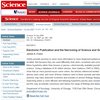
What is happening now that academic journals are going online? The abstract on the Science Magazine web site reads:
Online journals promise to serve more information to more dispersed audiences and are more efficiently searched and recalled. But because they are used differently than print—scientists and scholars tend to search electronically and follow hyperlinks rather than browse or peruse—electronically available journals may portend an ironic change for science. Using a database of 34 million articles, their citations (1945 to 2005), and online availability (1998 to 2005), James Evans shows that as more journal issues came online, the articles referenced tended to be more recent, fewer journals and articles were cited, and more of those citations were to fewer journals and articles. The forced browsing of print archives may have stretched scientists and scholars to anchor findings deeply into past and present scholarship. Searching online is more efficient and following hyperlinks quickly puts researchers in touch with prevailing opinion, but this may accelerate consensus and narrow the range of findings and ideas built upon.
So making journals available online has simply made researchers lazy? If you can find enough references for your literature review online, no need to bother searching any further?
A-maze-ing discoveries
Well, James Evans does make an interesting point, but it is quite the opposite of my personal experience. The more I find online, the more I get lost in backtracking interesting references. That’s how I make some a-maze-ing discoveries. And I am inclined to agree with the post author on The Scholarly Kitchen, who says that
Print-based browsing and the limited literature indexing of the past created a great inefficiency in the discovery process. While it is tempting to eulogize the end of scholarship, this article may signify that the dissemination of science is working more efficiently than ever. The institution of science values the progress of discovery followed by a consensus and closure of debate. That more of the literature is effectively being ignored may not necessarily signal a bad thing (although it may concern those who are not read).
I for one seem to find more and more references the deeper I dig, because it is available online, thus complelling me to search for more. To me, online journals are a blessing. James Evans may think they are a curse. I disagree.
Reference
Evans, J. (2008). Electronic Publication and the Narrowing of Science and Scholarship Science, 321 (5887), 395-399 DOI: 10.1126/science.1150473