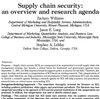
 Supply chain security is one of many components of a company’s overall supply chain risk management, and has grown in importance for many years already. Nonetheless, it’s only recently that I have come across and begun to look at it from an academical point of view. Today’s post is a critique of the journal article that cited the IBM white paper Investing in Supply Chain Security – Reaping Collateral Benefits, which I posted about 3 days ago. In Supply chain security: an overview and research agenda, Zachary Williams, Jason Lueg and Stephen Le May claim to have found four approaches in the literature on how organizations approach supply chain security.
A promising literature review
Being a literature review, the article boasts an impressive bibliography, and the authors have done a great job in putting it all together, thematically categorizing the literature and trying to piece together a full picture, which they do very well.
Four approaches
After discussing the concept of supply chain security, the article claims to have found four approaches in the literature on how organizations approach supply chain security:
- Intraorganizational
- Interorganizational
- Combination of 1) and 2)
- Ignore
I found this differentiation very interesting, because I haven’t thought about supply chain security (supply chain risk) in this way before, although it does seem pretty obvious that this is one of many possible frameworks.
Summary tables
The authors summarize their findings in a 3-page-table, listing the papers they have reviewed, along with the focus and particular findings of each paper, something that is very helpful in separating the chaff from the wheat, so to speak. What is surprising though is that most of the papers are conceptual or qualitative in nature, suggesting that there is not much quantitative research in this area, or is this a carefully selected study?
Research agenda
In the end, the authors come up with a four-fold research agenda that need further attention, namely
- Best practices for intraorganizational security activities
- Linking supply chain security activities with organizational performance
- Strategic typology of supply chain security activities
- Quantitative assessments
Conclusion
I have to agree that the quantitative element is maybe missing from much of the literature. On the other hand, security decisions are policy decisions and in my opinion policy decisions are more often than not qualitative rather than quantitative decisions, and that is maybe the right approach after all. Anyway, if you are looking for literature particularly on supply chain security, this article and its bibliography will go a long way.
Reference
Williams, Z., Lueg, J., & LeMay, S. (2008). Supply chain security: an overview and research agenda The International Journal of Logistics Management, 19 (2), 254-281 DOI: 10.1108/09574090810895988
Author links
- researchgate.net: Zachary Williams
- msstate.edu: Jason Lueg
- researchgate.net: Stephen LeMay
Related
- husdal.com: Investing in Supply Chain Security