Featured posts

  • Published. Not perished. Managing Risk in Virtual Enterprise Networks

    Publish or perish? Publish. It has taken its time, but finally it is there, the book that has my chapter in it. This book links Virtual Enterprise Networks with Supply Chain Management and Risk Management in a cross-disciplinary fashion. [ ... ]

  • Supply Chain Risk Management in six steps kiser-risk-management-six-steps

    Supply management is not just about acquiring goods and services at the best possible price. It’s also about identifying possible disruptions to the supply chain and taking steps to mitigate them. [ ... ]

2008/11/04 from the LITERATURE 9 reactions

A Future Research Agenda for Supply Chain Risk Management

When Manuj and Mentzer (2008) wrote their article titled Global Supply Chain Risk Management, they used Ghoshal (1987) Global Strategy: An Organizing Framework for developing sources of risk and Jüttner, Peck and Christopher (2003) Supply Chain Risk Management: Outlining an Agenda for Future Research for developing risk mitigation strategies. However, THAT is not why I am taking a closer look at the latter today. What brought said paper to my attention were the two simple figures it used. Why are the figures so striking?

Supply Chain Risk Management – a basic construct

In defining supply chain risk management, Jüttner et al. use four basic contructs: 1) Sources of risk, which lead to 2) Adverse Consequences of risk, instigated by 3) Drivers of risk and possibly offset by 4) Mitigation strategies.
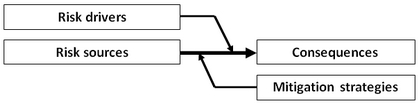
Supply Chain Risk Management - adapted from Jüttner, Peck and Christopher (2003)

Supply Chain Risk Management - from Jüttner, Peck and Christopher (2003)

These four constructs are used throughout the article and seen as sequential steps in the managerial process of addressing supply chain risk. It is a simplification, yet, at the same time, it opens up many new avenues that all converge towards the starting point, rather than diverge from it. In addressing the risk, they identify four separate risk mitigating strategies: 1) Avoidance, 2) Control, 3) Co-Operation and 4) Flexibility.

Supply Chain Risk Management – risk sources

In a similarly simple manner like the above figure, in a second figure the sources of risk are broadly categorized along 3 different levels: 1) Organizational risk, 2) Network (or Supply Chain)-related risk, and 3) Environmental risk.
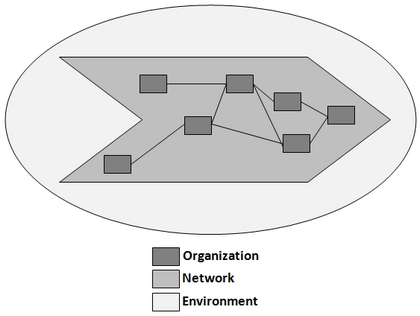
Supply Chain Risk Sources - adapted from Jüttner, Peck and Christopher (2003)

Supply Chain Risk Sources - from Jüttner, Peck and Christopher (2003)

In my opinion this figure perfectly manages to sum up the three different levels of supply chain risk. However, I haven’t yet seen any later paper that picks up along these lines.

Reference

Jüttner, U., Peck, H., & Christopher, M. (2003). Supply chain risk management: outlining an agenda for future research International Journal of Logistics, 6 (4), 197-210 DOI: 10.1080/13675560310001627016

Author links

Related

More from husdal.com

9 comments to A Future Research Agenda for Supply Chain Risk Management

  • Jukka Savolainen

    I found this article very interesting. Authors definition for SCRM is “the identification and management of risks for the supply chain, through co-ordinated approach amongst supply chain members, to reduce SC vulnerability”.

    Authors also define risk management strategies in supply chains such as control (internal) and co-operation. I was wondering if company manage its SC context risks internally is it SCRM or “logistics risk management”?

    I made a small ad-hoc survey in manufacturing companies and found out that co-operation or collaboration in risk management is quite rare. Many of the companies had only “effieciency-centric” collaboration but internal risk management in supply chains. Is there any good reaseach articles that has discussed this issue: internal SC risk management vs co-operative SC risk management?

    • Thanks for your comment, Jukka.

      I think you may be onto something here, because I can’t remember any articles discussing collaboration in SCRM, e.g.: company X helping managing the risk in company y, while company Z helps company X, or e.g.: a SCRM approach looking at all the risk in all the companies at the same time.

      I think no company would like to disclose to the rest of the supply chain where and how it is vulnerable. After all, all companies are snakes.

      There may be some pointers to collaborative risk management in my book chapter on risk in virtual enterprise networks. It’s not out yet, but I’d be happy to send you a draft.

  • Jukka Savolainen

    “A SCRM approach looking at all the risk in all the companies at the same time”

    I agree that SCRM focus is entire supply chain or network. But what I’m trying to say here is that, when companies go into SC collaboration usually first what they do is to improve productivity and enable better information sharing.

    Kampstra, Ashaeyri and Gattorna (2006, 326) have defined “the ladder of collaboration” from arm’s lenght – communication – coordination – intensive collaboration – partnerships – (to joint ventures).

    On which level of above collaboration supply chain risk management process usually comes along? Of course it depends on industry and nature of the product.

    “I think no company would like to disclose to the rest of the supply chain where and how it is vulnerable”

    I agree this, which might mean that those companies which have decided to implement collaborative SCRM process and to disclose risk information must share trust and common goals. But what about companies which have decided not to share risk information but have still implemented some sort of supply chain risk management process internally.

    Is it SCRM or “logistics risk management”? There are hardly “logistics risk management”.

    These are just a thoughts.

    PS. I would really like to read your opening chapter draft. I guess you have my e-mail.

    Ref.
    Kampstra, Ashaeyri & Gattorna (2006) Realities of SC collaboration. The International Journal of Logistics Management Vol. 17, No.3, pp. 312-330.

  • Sadjad

    Hi,

    It’s an interesting conversation! In fact, In my research I wanted to investigate the impact of collaboration on effective SCRM and particularly to develop a collaborative risk management framework which I left the idea behind because I really didn’t know how to approach it, whether to look at it from a theory perspective or so on… I did not find any good attempt in explaining the collaboration-SCRM although 99% of literature highlight the importance of collaboration in SCRM. The article by Hallikas only state that in strategic relationships buyer and supplier will have a collaborative risk management and learning but did not discuss about this collaborative risk management in detail.

    Would be happy to have your insights and ideas in this regard.

    Hallikas, J., Puumalainen, K., Vesterinen, T., & Virolainen, V.-M. (2005). Risk-based classification of supplier relationships. Journal of Purchasing & Supply Management, 11(2-3), 72-82.

  • Jukka Savolainen

    I see that in any SCRM process collaboration is a key. If there are no collaboration it is only risk management. I think one way to study this topic is figure out who is the channel leader and has channel leader implemented SCRM to its suppliers and customers.

    I’ve read Hallikas’ papers and unfortunately they don’t define this learning issue in more detail. But I think that any risk management process needs some kind of learning and especially if it takes place between two different organisations.

  • Jukka Savolainen

    Does supply chain collaboration exist, or like the elusive Yeti, is it only rumored to exist?

    http://logipi.com/Logipi-SCM.aspx?PID=575&NewsID=253772

Leave a Reply


You can use these HTML tags

<a href="" title=""> <abbr title=""> <acronym title=""> <b> <blockquote cite=""> <cite> <code> <del datetime=""> <em> <i> <q cite=""> <strike> <strong>