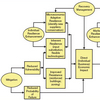
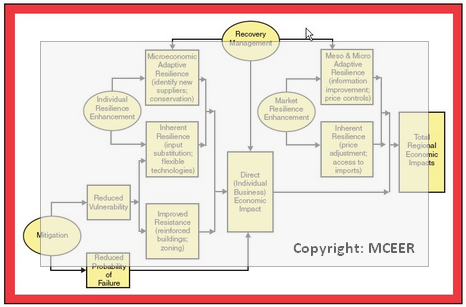
 Economic resilience, as defined a paper published by the Multidisciplinary Center for Earthquake Engineering Research (MCEER), refers to the inherent and adaptive responses to hazards that enable individuals and communities to avoid some potential losses. It can take place at the level of the firm, household, market, or macroeconomy.
What is economic resilience?
In contrast to the pre-event character of mitigation, economic resilience emphasizes ingenuity and resourcefulness applied during and after the event. Also, while mitigation often emphasizes new technology (e.g., seismic warning) or institutions (e.g., insurance markets), resilience has greater behavioral emphasis. It focuses on the fact that individuals and organizations do not simply react passively or in a “business as usual manner” in the face of a disaster.
The measurement of resilience is important because it enables us to evaluate an important strategy for reducing economic losses from disasters, since individual companies’ supply chain resilience contribute to the overall economic resilience of a region. Failure to incorporate resilience in loss estimation will result in inflated assessments of business interruption from diasters. Failure to include resilience in policy-making will result in missed opportunities to further reduce losses.
 Adam Rose, one of the proponents of the MCEER economic resilience framework has recently co-written a paper on transportation resilience. Mind you, transportation networks are an important contributor towards economic resilience, particularly when it comes to recovering from a disaster. Remember, without roads, nothing works.
Resilience is also an important issue in the New Zealand research project Resilient Organisations. Although not focusing specifically on economic resilience, there are many bearings between organisational, societal, and economic resilience.
Downloads
- buffalo.edu: Measuring economic resilience
Links
- resorgs.org.nz: Resilient organisations
Related
- husdal.com: Transportation security and resilience
- husdal.com: Engineering transportation lifelines
- husdal.com: Are roads more important than computers?